


Natural sources of antioxidants in your daily diet.

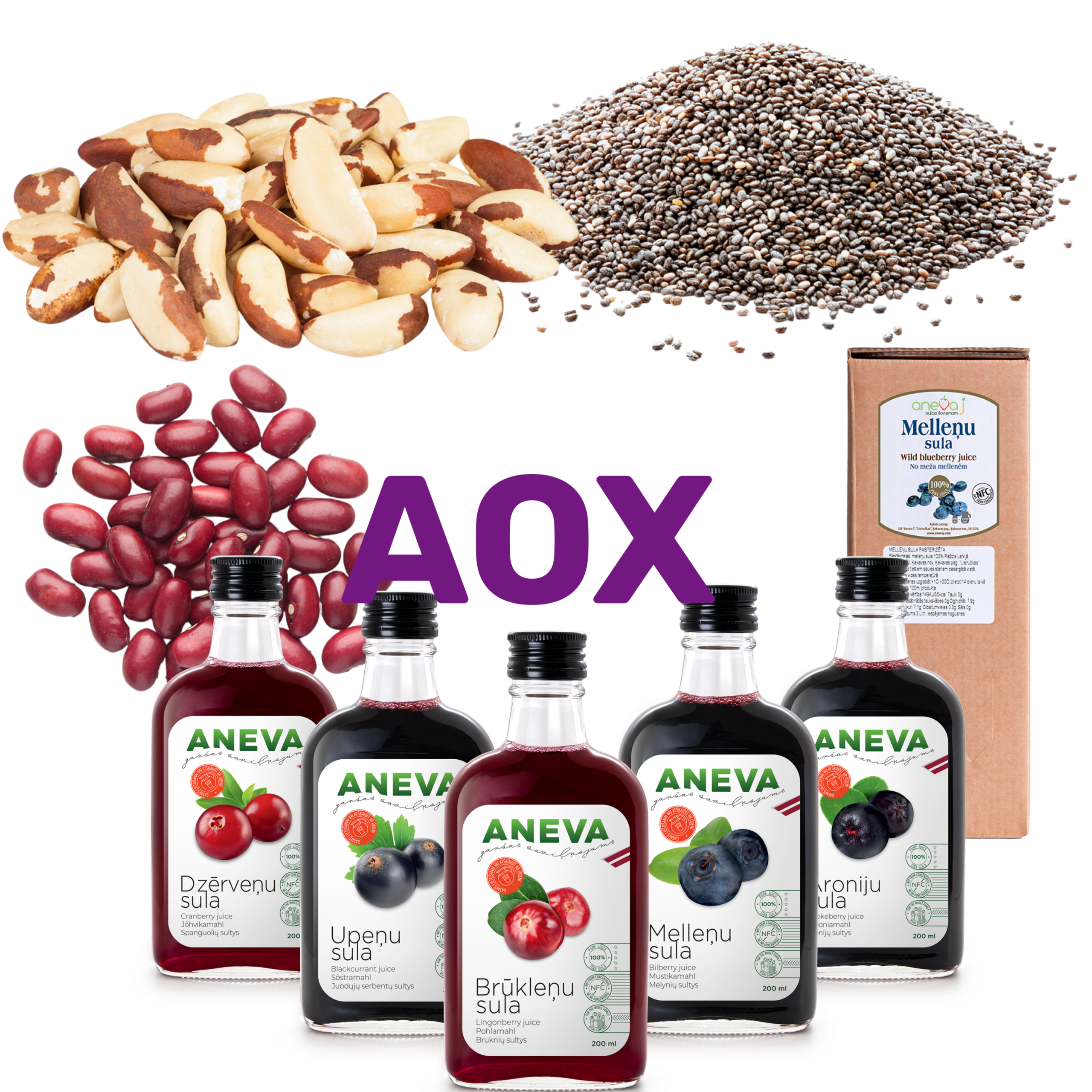
Antioxidants are natural biologically active substances that help protect the body’s cells against oxidative stress and the effects of free radicals. Research most frequently highlights compounds from the polyphenol group – anthocyanins, flavonoids, proanthocyanidins and phenolic acids. Dark berries, berry juices, pulses, seeds and certain nuts are particularly rich sources of antioxidants [1][2][3].
Research shows that incorporating a variety of plant-based foods into the diet helps to provide the body with a wide range of antioxidants [2].
Note: There is no official ‘recommended daily intake’ for antioxidants. The scientific literature suggests that ‘5 portions of fruit and vegetables’ a day can provide more than 500 mg of polyphenols [4].
Natural sources of antioxidants
| Product | Antioxidant compounds | Approximate amount per 100 g / 100 ml | % of the 500 mg polyphenol reference |
|---|---|---|---|
| Chokeberry juice | Anthocyanins, flavonols, proanthocyanidins [5][6] | ~1,700–3,000 mg of polyphenols [5][6] | ~340–600% [4][5] |
| Blackcurrant juice | Anthocyanins, flavonols and other polyphenols [7][8] | ~500–1,300 mg of polyphenols [8] | ~100–260% [4][8] |
| Blueberry juice | Anthocyanins, flavonols [3][9] | ~560–836 mg of polyphenols [9] | ~112–167% [4][9] |
| Cranberry juice | Proanthocyanidins and other polyphenols [10][11] | ~300–400 mg of polyphenols [11] | ~75% [4][10] |
| Lingonberry juice | Anthocyanins, phenolic acids [5][11] | ~200–600 mg of polyphenols [11] | ~40–120% [4][11] |
| Freeze-dried raspberries | Ellagitannins, anthocyanins [4][12] | ~215 mg of polyphenols in fresh raspberries [12] | ~43% [4][12] |
| Freeze-dried strawberries | Anthocyanins, ellagic acid [4][13] | ~235 mg of polyphenols in fresh strawberries [13] | ~47% [4][13] |
| Chia seeds | Phenolic acids, tocopherols [14] | Moderate antioxidant activity [2][14] | not specified |
| Red/speckled beans | Flavonoids, polyphenols [2][4] | High antioxidant activity [2][4] | not specified |
| Brazil nuts | Selenium, tocopherols [15][16] | High antioxidant activity [15][16] | not specified |
Note: The concentration of antioxidants per 100 g is higher in freeze-dried products than in fresh berries, as the drying process removes water whilst retaining a large proportion of the polyphenols and anthocyanins [17][18].
How to increase the intake of antioxidants in the body?
Research shows that combining different plant-based products helps to ensure a more varied intake of bioactive compounds [2][4].
Some antioxidants and phytonutrients are better absorbed by the body when consumed with fats, so it is advisable to combine berries and vegetables with seeds or nuts from time to time [19].
Studies have also shown that prolonged heating and storage can reduce the levels of certain polyphenols and other bioactive compounds in food [8][21].
Recommended:
- include a variety of berries and plant-based foods in your diet on a regular basis [2][4];
- combine berries with seeds and nuts [19][20];
- avoid excessive heat treatment of products [8][21];
- maintain a varied diet on a daily basis [2].
Conclusions
Dark berries, natural berry juices, freeze-dried berries, chia seeds, beans and Brazil nuts are among the most valuable natural sources of antioxidants in the diet. Aronia berries, blackcurrants and blueberries are particularly rich in polyphenols [2][5][8][9].
A varied diet containing a range of plant-based foods helps the body to absorb a wide spectrum of bioactive compounds on a daily basis [2].
Products by Category
-

Natural cranberry juice, 200ml, ANEVA
€2.80GAB -

Natural cranberry juice, 3L, ANEVA
€24.50GAB -

Natural cherry juice, 3L, ANEVA
€24.50GAB -

Natural cranberry juice, 500ml, ANEVA
€5.25GAB -
Natural black elderberry juice, 200ml, ANEVA
Original price was: €2.70.€2.43Current price is: €2.43.GAB -

Natural apple and sea buckthorn juice, 3L, ANEVA
€8.45GAB -

Natural cherry juice, 200ml, ANEVA
€2.80GAB -
Roasted black soya beans with salt
Original price was: €9.00.€8.55Current price is: €8.55.KG -

Natural sea buckthorn juice, 200ml, ANEVA
€2.80GAB

_PASPUGRME-430x283.png)
References
[1] Plant polyphenols as dietary antioxidants
https://pmc.ncbi.nlm.nih.gov/articles/PMC2835915/
[2] Carlsen MH et al. “The total antioxidant content of more than 3,100 foods”
https://pmc.ncbi.nlm.nih.gov/articles/PMC2841576/
[3] Phenol-Explorer – Blueberries
https://phenol-explorer.eu/contents/food/95
[4] Scalbert A. “Identification of the 100 richest dietary sources of polyphenols”
https://www.researchgate.net/profile/Augustin-Scalbert-3/publication/47661728_Identification_of_the_100_richest_dietary_sources_of_polyphenols_An_application_of_the_Phenol-Explorer_database/links/54579f840cf2bccc49111128/Identification-of-the-100-richest-dietary-sources-of-polyphenols-An-application-of-the-Phenol-Explorer-database.pdf
[5] Underutilised Chokeberry Accessions Are Rich Sources of Anthocyanins, Flavonoids, Hydroxycinnamic Acids, and Proanthocyanidins
https://pubs.acs.org/doi/10.1021/jf402449q
[6] Effects of Weather Conditions on Phenolic Content and Antioxidant Capacity in Aronia Juice
https://journal.pan.olsztyn.pl/Effects-of-Weather-Conditions-on-Phenolic-Content-and-Antioxidant-Capacity-in-Juice%2C98480%2C0%2C2.html
[7] Extraction, Identification, and Health Benefits of Blackcurrant Anthocyanins
https://www.mdpi.com/2076-3417/11/4/1863
[8] Phenolic composition and antioxidant capacity of blackcurrant juices
https://www.sciencedirect.com/science/article/abs/pii/S0308814621008955
[9] Study on the polyphenol content
of blueberries https://www.sciencedirect.com/science/article/pii/S0002916523463009
[10] Cranberry: Chemical Composition, Antioxidant Activity and Impact on Human Health
https://pmc.ncbi.nlm.nih.gov/articles/PMC8911768
[11] Evaluation of phenolic compounds in cranberries and cranberry products
[12] Raspberry polyphenol data
https://www.healthline.com/health/polyphenols-foods
[13] Strawberry polyphenol data
https://www.healthline.com/health/polyphenols-foods
[14] Chia Seeds (Salvia hispanica L.): An Overview
https://pmc.ncbi.nlm.nih.gov/articles/PMC6994964
https://pmc.ncbi.nlm.nih.gov/articles/PMC8700994
[16] Comparison of the Effects of Brazil Nut Oil and Soybean Oil on Oxidative Stress
https://pmc.ncbi.nlm.nih.gov/articles/PMC7019763
[17] Polyphenol and Flavonoid Stability of Wild Blueberries during Freeze-Drying
https://www.mdpi.com/2304-8158/12/4/871
[18] Effect of freeze-drying on the antioxidant compounds and antioxidant activity of selected tropical fruits
https://www.mdpi.com/1422-0067/12/7/4678
[20] Plant polyphenols as dietary antioxidants
https://pmc.ncbi.nlm.nih.gov/articles/PMC2835915/
[21] Effects of processing and storage on antioxidant compounds in foods
https://pmc.ncbi.nlm.nih.gov/articles/PMC6049644/


